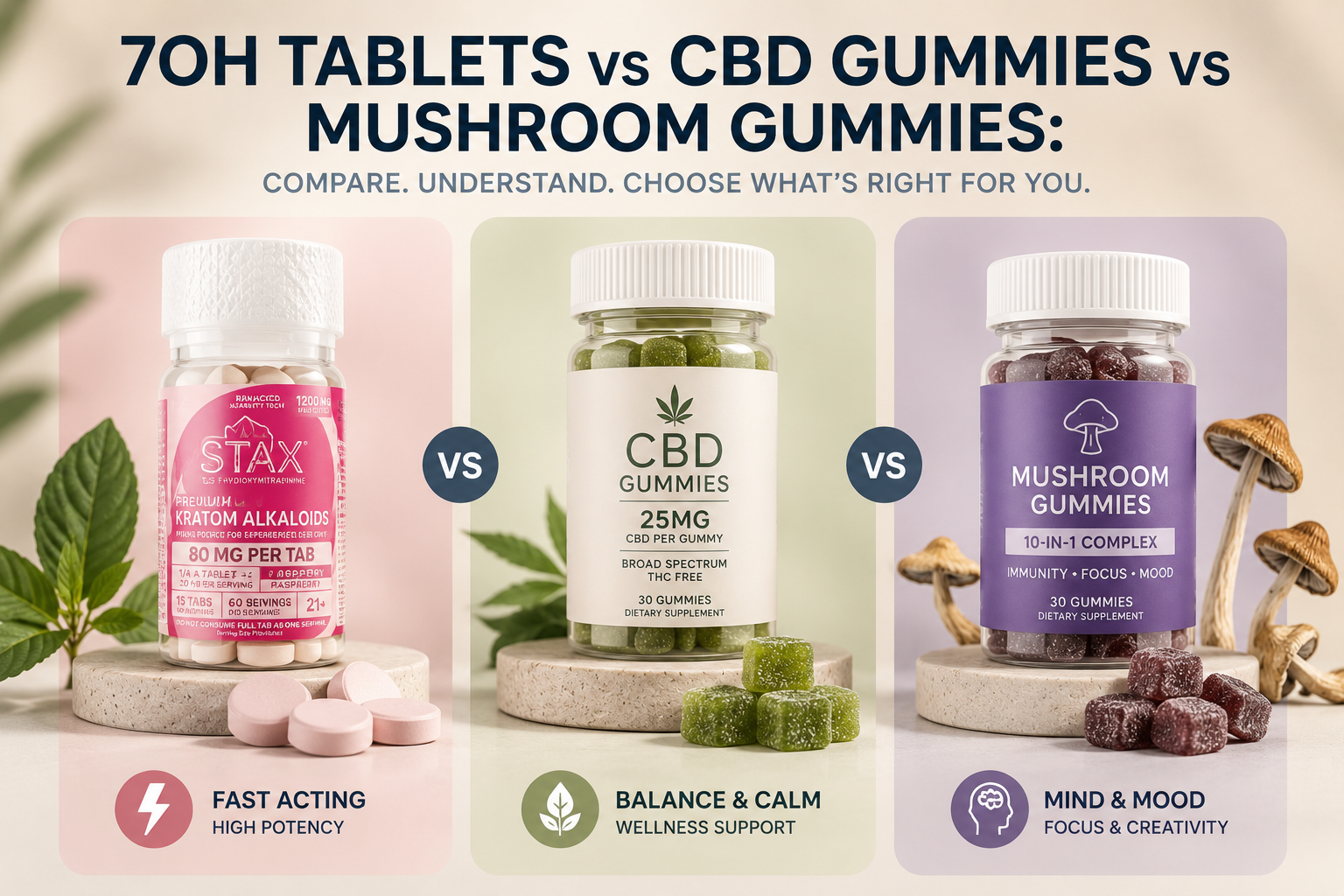
If you shop online, visit smoke shops, or browse wellness products, you have probably seen three product types getting a lot of attention: 7OH tablets, CBD gummies, and mushroom gummies.
At first, they may seem similar because all three are often marketed as convenient, easy-to-use products for adults. But they are very different categories.
7OH tablets are usually connected to 7-hydroxymitragynine, a concentrated kratom-related alkaloid. CBD gummies contain cannabidiol, a non-intoxicating compound from cannabis or hemp. Mushroom gummies may contain functional mushrooms, Amanita muscaria, muscimol, psilocybin-style branding, or unclear proprietary blends.
That means shoppers should not compare these products by packaging or marketing language alone. The real comparison should focus on:
- What active ingredient is inside?
- How much is in each serving?
- Is the product legal where you live?
- Does the label clearly explain the formula?
- Are there FDA, CDC, or safety concerns?
- Does the product make medical claims?
This guide explains 7OH tablets vs CBD gummies vs mushroom gummies in simple language so you can understand the differences and compare products more responsibly.
Important note: This article is for educational purposes only. 7OH, CBD, and mushroom gummies should not be treated as approved cures or treatments unless specifically approved by the FDA for a particular medical use. The FDA recommends consumers avoid 7OH products, and it has raised safety concerns around many CBD and mushroom products.
Table of Contents
ToggleQuick Answer: 7OH Tablets vs CBD Gummies vs Mushroom Gummies
7OH tablets are usually higher-concern, concentrated alkaloid products containing or marketed around 7-hydroxymitragynine. CBD gummies are edible products containing cannabidiol, usually hemp-derived, and are commonly marketed for wellness even though most CBD products are not FDA-approved. Mushroom gummies are a broad and often confusing category that may contain non-psychoactive functional mushrooms, Amanita/muscimol ingredients, or undisclosed compounds.
|
Product Type |
Main Ingredient Category |
Common Format |
Biggest Buyer Concern |
|
7OH Tablets |
7-hydroxymitragynine, a kratom-related alkaloid |
Tablets, chewables, capsules |
FDA warnings, potency, legality, addiction/withdrawal risk |
|
CBD Gummies |
Cannabidiol from cannabis/hemp |
Gummies, edibles |
CBD amount, THC content, drug interactions, quality control |
|
Mushroom Gummies |
Functional mushrooms, Amanita/muscimol, or unclear blends |
Gummies, chocolates, edibles |
Ingredient identity, legality, undisclosed substances, contamination |
The biggest takeaway: these products are not interchangeable. They come from different ingredient categories, have different safety profiles, and require different label checks.
What are 7OH Tablets?
7OH stands for 7-hydroxymitragynine. It is a kratom-related alkaloid that occurs naturally in trace amounts in kratom, but many modern 7OH products contain added or enhanced levels of 7OH.
7OH tablets are often marketed as:
- High-potency tablets
- Chewable tablets
- Kratom alkaloid tablets
- 7-hydroxymitragynine tablets
- Alternative wellness products
- Fast-use or portable products
The FDA has warned that 7OH products, including tablets, gummies, drink mixes, and shots, are novel potent opioid products that have not been proven safe or effective for any use and should be avoided. The FDA also states that 7OH is not approved for medical use and is not lawful as a dietary supplement or when added to conventional foods.
What to Check Before Buying 7OH Tablets
Before comparing any 7OH tablet, check:
- Milligrams of 7OH per tablet
- Milligrams of 7OH per serving
- Whether it contains MIT, Pseudo, or other alkaloids
- Total package strength
- Tablet count
- Suggested serving size
- Lab testing or COA information
- Shipping restrictions
- Warning and disclaimer language
- Whether the product avoids medical claims
Why 7OH Tablets Need Extra Caution?
7OH products have received strong FDA attention because concentrated 7OH is different from natural kratom leaf. The FDA has reported harmful effects associated with 7OH products, including addiction, anxiety, depression, gastrointestinal distress, insomnia, seizures, and withdrawal symptoms.
What Are CBD Gummies?
CBD stands for cannabidiol, a compound found in cannabis. CBD is different from THC, the compound most commonly associated with the “high” from marijuana. The CDC states that CBD is not impairing, meaning it does not cause a high.
CBD gummies are edible products that usually contain hemp-derived CBD. They are commonly marketed around:
- Calm
- Sleep
- Recovery
- Daily wellness
- Relaxation
- Balance
- Stress support
However, shoppers should be careful with these claims.
The FDA has approved only one CBD product: a prescription drug used to treat seizures associated with Lennox-Gastaut syndrome, Dravet syndrome, or tuberous sclerosis complex. The FDA has not approved most over-the-counter CBD gummies and says it is currently illegal to market CBD by adding it to food or labeling it as a dietary supplement.
What to Check Before Buying CBD Gummies
Before comparing CBD gummies, check:
- CBD mg per gummy
- CBD type: isolate, broad-spectrum, or full-spectrum
- THC content
- Serving size
- Total CBD per container
- Third-party lab testing
- Whether the product has a QR code or batch COA
- Other ingredients, such as melatonin or herbs
- Whether the product makes medical claims
- Whether you take medications that could interact with CBD
Why CBD Gummies Need Careful Label Review?
CBD is often seen as mild or low-risk, but the FDA says CBD can cause liver injury, interact with medications, and increase sedation when combined with alcohol or other drugs that slow brain activity. The FDA also says some CBD products are marketed with unproven medical claims and may be of unknown quality.
What are Mushroom Gummies?
Mushroom gummies are one of the most confusing product categories because the phrase can mean very different things.
A mushroom gummy may contain:
- Functional mushrooms like lion’s mane, reishi, cordyceps, or chaga
- Amanita muscaria extract
- Muscimol
- Ibotenic acid
- Psilocybin-style branding
- “Magic mushroom” style claims
- Proprietary mushroom blends
- Undisclosed ingredients
This is why shoppers should not assume all mushroom gummies are the same.
Functional Mushroom Gummies
Functional mushroom gummies usually focus on non-psychoactive mushrooms such as:
- Lion’s mane
- Reishi
- Chaga
- Cordyceps
- Turkey tail
These products are often marketed around focus, immunity, energy, or daily wellness. Even then, shoppers should check the mushroom species, extract amount, beta-glucan content where available, and whether the product makes unsupported medical claims.
Amanita or Muscimol Mushroom Gummies
Some mushroom gummies are marketed as “legal psychedelics,” “magic mushroom gummies,” or “Amanita gummies.” These may contain Amanita muscaria, muscimol, or related constituents.
The FDA has warned that Amanita muscaria, its extracts, and certain constituents such as muscimol, ibotenic acid, and muscarine are not authorized for use as ingredients in conventional food and may be harmful. The FDA also recommends people avoid foods with these ingredients.
Psilocybin-Style Mushroom Gummies
Some products use “magic mushroom” language that may imply psilocybin or psychedelic effects. This is especially risky because labels may be vague, and products may contain undisclosed compounds.
The CDC reported a 2024 outbreak linked to Diamond Shruumz mushroom chocolates, cones, and gummies. As of October 31, 2024, CDC reported 180 illnesses, 73 hospitalizations, and 3 potentially associated deaths; FDA testing identified multiple substances in product samples, including O-acetylpsilocin, psilocin, kavalactones, pregabalin, and muscimol.
7OH Tablets vs CBD Gummies vs Mushroom Gummies: Side-by-Side Comparison
|
Factor |
7OH Tablets |
CBD Gummies |
Mushroom Gummies |
|
Main Ingredient |
7-hydroxymitragynine |
Cannabidiol |
Functional mushrooms, Amanita, muscimol, or unclear blends |
|
Product Category |
Kratom-related alkaloid product |
Cannabis/hemp-derived product |
Mushroom-based edible product |
|
Common Format |
Tablets or chewables |
Gummies |
Gummies, chocolates, edibles |
|
Psychoactive Concern |
FDA describes 7OH as a potent opioid product |
CBD itself is not impairing, but THC content matters |
Depends on ingredient; Amanita/muscimol or undisclosed compounds may be psychoactive |
|
FDA Status |
No FDA-approved 7OH products; FDA recommends avoiding |
Only one FDA-approved CBD prescription drug; most CBD gummies are not FDA-approved |
Amanita/muscimol not authorized in food; psilocybin-related products may be illegal |
|
Main Label Check |
7OH mg per serving |
CBD mg and THC content |
Mushroom species and active compound |
|
Major Risk |
Potency, addiction, withdrawal, seizures, legality |
Drug interactions, liver injury, THC contamination, unproven claims |
Undisclosed ingredients, intoxication, contamination, legality |
|
Best Buyer Question |
“How much 7OH is in one serving?” |
“How much CBD and THC are in each gummy?” |
“What exact mushroom or compound is inside?” |
Ingredient Differences: Why the Active Compound Matters
The most important difference between these products is the active ingredient.
7OH Tablets: Alkaloid-Based
7OH is connected to kratom alkaloid chemistry. It is not the same as CBD or mushrooms. It requires extra caution because concentrated 7OH products have received FDA warnings and enforcement attention.
CBD Gummies: Cannabinoid-Based
CBD is a cannabinoid. It is not the same as THC, though CBD products may contain THC depending on the formula. The CDC notes that many businesses selling hemp and CBD products also sell THC-containing products, so consumers should be careful not to confuse them.
Mushroom Gummies: Mushroom or Psychedelic-Branded
Mushroom gummies may be functional, psychoactive, or unclear. A lion’s mane gummy is very different from an Amanita muscaria gummy or a product using “magic mushroom” branding.
Product Format Differences
7OH Tablets
Tablets are usually designed for portability and portion control. However, because 7OH products can be concentrated, shoppers should review whether the listed amount is per tablet, per serving, or per package.
CBD Gummies
CBD gummies are familiar because they look like candy-style edibles. That convenience can create risk. The FDA has raised concerns about CBD products in forms appealing to children, such as gummies, hard candies, and cookies, because they may be mistaken for regular food and may cause harm.
Mushroom Gummies
Mushroom gummies may also look like candy, which can make accidental consumption a concern. CDC has warned that psychoactive mushroom products are often sold as gummy candies, chocolates, or snack foods and may contain undisclosed ingredients or harmful contaminants.
How to Compare These Products Before Buying?
1. Start With the Exact Active Ingredient
Do not buy based on broad category names alone.
Ask:
- Does the 7OH tablet clearly list 7-hydroxymitragynine?
- Does the CBD gummy clearly list CBD and THC content?
- Does the mushroom gummy clearly list the mushroom species?
- Does the mushroom gummy include muscimol, Amanita, psilocybin-style compounds, or unclear blends?
If the active ingredient is vague, that is a red flag.
2. Check Milligrams Per Serving
Each category uses milligrams differently.
For 7OH tablets, check:
- 7OH mg per tablet
- 7OH mg per serving
- Total 7OH per pack
For CBD gummies, check:
- CBD mg per gummy
- THC mg per gummy
- CBD type: isolate, broad-spectrum, or full-spectrum
For mushroom gummies, check:
- Mushroom extract mg
- Muscimol amount, if present
- Beta-glucan content, if functional mushrooms are used
- Whether the label lists active compounds or only a proprietary blend
3. Look for Third-Party Lab Testing
Lab testing is one of the most important trust signals.
A useful lab report should ideally confirm:
- Active ingredient amount
- Contaminants
- Heavy metals
- Microbial safety
- Pesticides
- Residual solvents
- THC content for CBD products
- 7OH and mitragynine levels for 7OH products
- Mushroom species or active compounds for mushroom products
A product without testing is harder to trust.
4. Avoid Medical Claims
Be cautious with any product claiming to treat:
- Stress
- Anxiety
- Depression
- Pain
- Sleep disorders
- PTSD
- Opioid withdrawal
- Addiction
- Cancer
- Neurological conditions
- Any disease or medical condition
The FDA has warned about unapproved CBD products marketed with therapeutic claims, and it has also noted that some 7OH products are marketed with unproven claims such as pain relief or managing anxiety.
5. Check Legal Restrictions
Legality can vary widely by product type and location.
Before buying, check:
- Federal rules
- State rules
- County restrictions
- City restrictions
- Shipping restrictions
- Product-specific ingredient rules
- Whether the product is lawful as a food, supplement, drug, or consumer product
This is especially important for 7OH products, CBD edibles, and mushroom gummies with Amanita, muscimol, or psilocybin-style claims.
6. Consider Drug Testing and Medication Interactions
CBD products may contain THC, especially full-spectrum formulas. That can matter for workplace drug testing.
CBD may also interact with medications. The FDA says CBD can affect how other medicines work, and other medicines can affect the dose of CBD that can be safely used.
For 7OH and mushroom products, shoppers should also avoid mixing with alcohol, sedatives, or other substances without speaking to a healthcare professional.
Which Product Is Best for Which Shopper?
This is not about saying one is “best.” It is about understanding the category.
7OH Tablets May Appeal to Shoppers Who Want Alkaloid-Based Products
7OH tablets may appeal to people researching concentrated kratom-related alkaloid products. However, this category carries major FDA warnings and should be approached with caution.
Best label focus:
- 7OH mg per serving
- Alkaloid breakdown
- Warning language
- Lab testing
- Shipping restrictions
CBD Gummies May Appeal to Shoppers Looking for Non-Impairing Hemp-Derived Products
CBD gummies are often positioned as wellness products and are generally better known than 7OH or mushroom gummies. However, shoppers should not assume CBD products are risk-free.
Best label focus:
- CBD amount
- THC amount
- CBD type
- Medication interactions
- Lab testing
- Avoiding unapproved medical claims
Mushroom Gummies May Appeal to Shoppers Interested in Functional or Mushroom-Based Products
Mushroom gummies require the most ingredient clarification because the category can mean many things.
Best label focus:
- Mushroom species
- Functional vs psychoactive positioning
- Amanita/muscimol content
- Psilocybin-style claims
- Lab testing
- Contaminants and undisclosed ingredients
Common Mistakes Shoppers Make
Mistake 1: Assuming All Gummies Are Mild
CBD gummies and mushroom gummies may look like candy, but they can contain active compounds. Always read the label.
Mistake 2: Treating 7OH Tablets Like Regular Kratom Leaf
Concentrated 7OH products are different from natural kratom leaf products. The FDA warning focuses on 7OH as an added ingredient or at enhanced levels.
Mistake 3: Thinking CBD Means THC-Free
Some CBD products may contain THC, especially full-spectrum formulas. Always check the COA.
Mistake 4: Assuming “Mushroom Gummies” Means Functional Mushrooms
Some mushroom gummies contain or claim to contain Amanita, muscimol, or psychedelic-style ingredients. Others may contain undisclosed substances.
Mistake 5: Ignoring Medical Claims
If a product claims to treat anxiety, pain, depression, sleep disorders, or disease, review it carefully. Unapproved medical claims are a major red flag.
Mistake 6: Not Checking Local Laws
7OH, CBD, and mushroom products may all face different rules depending on where you live.
Final Takeaway: Compare the Ingredient, Not the Packaging
When comparing 7OH tablets vs CBD gummies vs mushroom gummies, the most important thing is understanding what is actually inside the product.
7OH tablets are concentrated kratom-related alkaloid products and have received strong FDA warnings. CBD gummies contain cannabidiol and are widely available, but most are not FDA-approved and may carry risks such as drug interactions, liver injury, THC content, and quality concerns. Mushroom gummies are the broadest and most confusing category because they may contain functional mushrooms, Amanita/muscimol, psilocybin-style compounds, or undisclosed ingredients.
Before buying any of these products, compare:
- Active ingredient
- Milligrams per serving
- Total package strength
- Lab testing
- Legal status
- Warning language
- Medical claims
- Drug interaction risks
- Shipping restrictions
- Company transparency
For shoppers researching 7OH products, 7OH.com can help compare clearly labeled tablets by potency, format, and brand. But no matter what product type you are considering, the smartest first step is always the same: read the label, verify the testing, and avoid products that make unsupported health claims.
FAQs About 7OH Tablets vs CBD Gummies vs Mushroom Gummies
Q. What is the main difference between 7OH tablets, CBD gummies, and mushroom gummies?
7OH tablets contain or are marketed around 7-hydroxymitragynine, a kratom-related alkaloid. CBD gummies contain cannabidiol from cannabis or hemp. Mushroom gummies may contain functional mushrooms, Amanita, muscimol, or unclear mushroom blends.
Q. Are 7OH tablets FDA-approved?
No. The FDA states there are no FDA-approved products containing 7OH and recommends that consumers avoid 7OH products.
Q. Are CBD gummies FDA-approved?
Most CBD gummies are not FDA-approved. The FDA has approved only one CBD prescription drug for certain seizure disorders and says it is currently illegal to market CBD by adding it to food or labeling it as a dietary supplement.
Q. Are mushroom gummies safe?
It depends on what they contain. Functional mushroom gummies are different from Amanita or psychedelic-style gummies. FDA and CDC have raised concerns about Amanita ingredients and mushroom products with undisclosed or harmful substances.
Q. Do CBD gummies get you high?
CBD itself is not impairing and does not cause a high, according to the CDC. However, some CBD products may contain THC, so shoppers should check the lab report.
Q. Are mushroom gummies the same as magic mushrooms?
Not always. Some mushroom gummies contain functional mushrooms like lion’s mane or reishi. Others may use Amanita, muscimol, or “magic mushroom” style branding. Always check the exact ingredient.
Q. What should I check before buying 7OH tablets?
Check 7OH milligrams per serving, total package strength, other alkaloids, lab testing, warning language, shipping restrictions, and whether the product avoids medical claims.
Q. What should I check before buying CBD gummies?
Check CBD mg per gummy, THC content, CBD type, serving size, third-party lab testing, medication interaction warnings, and whether the product makes unapproved medical claims.
Q. What should I check before buying mushroom gummies?
Check the mushroom species, active compounds, whether the product contains Amanita or muscimol, lab testing, contaminant testing, legal restrictions, and whether the label uses vague “proprietary blend” language.
Q. Which is better: 7OH tablets, CBD gummies, or mushroom gummies?
None is automatically better. They are different product categories with different ingredients, risks, and legal considerations. The better choice depends on ingredient transparency, lab testing, local legality, and whether the product avoids unsupported health claims.